
10 minutes
What Black Friday Really Reveals About Scaling Ecommerce
Lessons from Richie Mashiko on media mix, forecasting, and building businesses that last
Black Friday Cyber Monday tends to compress an entire year’s worth of decisions into a single week. Media strategy, forecasting assumptions, operational discipline, and leadership alignment all show up at once.
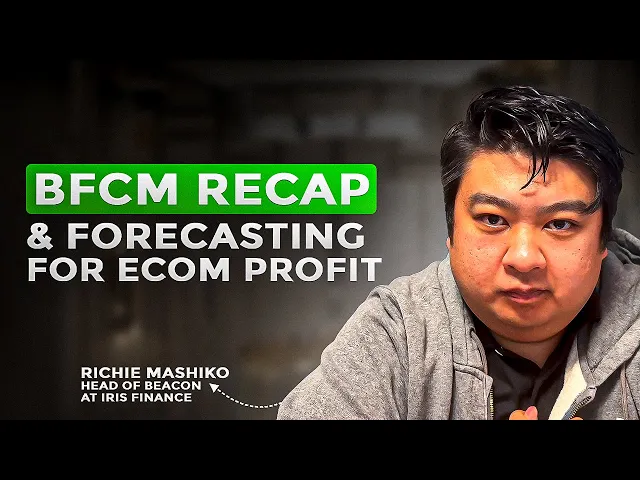
In a recent conversation on the Marketing Operators podcast, Richie Mashiko, who helps lead the Customer Success team at Iris, reflected on why this past Black Friday stood out as one of the most revealing of his career. And no, it wasn’t because everything went perfectly, but rather because the outcomes made it clear which foundations were solid and which were not.
“By far, this was the smoothest Black Friday Cyber Monday,” Richie said. “It was a night and day difference compared to the year before.”
And that contrast came from years of experience, including moments when things didn't go smoothly at all.
Scrappy beginnings that led to real scale
Richie’s perspective is shaped by having grown up with ecommerce. Long before forecasting models and media mix debates, he was running ads, building early versions of websites, and figuring things out alongside friends who would later become operators in the industry.
“I built the first version of the Birdie website. I bought the ads. This was back when CPMs were incredibly low,” Richie said. “We thought we were geniuses getting four to five times return on the platform.”
That early success was exciting, but it also taught him something important. Growth that looks easy early on rarely stays that way.
As Birdie scaled, Richie naturally shifted toward finance and operations. Someone needed to build forecasts, manage cash flow, and understand what growth actually meant for the business.
“The joke I make is that spreadsheets made more sense to me than reviewing ad hooks,” he said. “So I started building the forecast, learning demand planning, and really understanding the FP&A side of ecommerce.”
That blend of growth intuition and financial rigor is what Richie now brings to his work at Iris.
When Black Friday feels heavy, something is off
One of the most relatable moments in the conversation came when Richie reflected on a previous year that felt very different from this one.
“I remember finishing one year and telling the executive team, ‘I don’t know how many more of these I can do,’” he said. “It was extremely stressful. Every dollar felt scrutinized.”
That experience shaped how he evaluates Black Friday today. Smooth execution shouldn’t be shrouded in adrenaline or heroics. It should be about reducing stress through preparation and realism.
This year, across many brands he works with, Richie noticed a clear divide. Teams that had aligned expectations, diversified media, and planned realistically felt calm. Teams that had not were forced into reactive decisions.
Media mix should be a priority
One of Richie’s most repeated observations from this Black Friday was how clearly media mix diversification separated outcomes.
“The brands that struggled at scale were the ones that never really figured out how to diversify their media mix,” he said.
This was not theoretical. Richie saw it play out across brands of all different sizes.
Some teams were still heavily concentrated in Meta, watching efficiency decline while reach stagnated. Others had spent the year investing in YouTube, linear TV, creators, and awareness campaigns that did not always look efficient in isolation.
“Meta can probably squat 400 pounds,” Richie joked. “Linear TV can run a ten mile race at a six thirty pace.”
Different channels build different kinds of strength. Brands that tried to make every channel behave like direct response inevitably pulled back too soon.
When efficiency matters more than growth
Not every Black Friday story Richie shared was about scale. One of the most telling anecdotes came from a brand that had been in a distressed state earlier in the year.
“We owed Facebook a lot of money,” Richie said. “We didn’t run ads for most of the year. We started again in October spending maybe one hundred to five hundred dollars a day.”
Historically, that brand had spent tens of thousands per day. Going into Black Friday, there was no clear expectation of what would happen.
“It ended up being really profitable,” Richie said. “We didn’t reach the scale of previous years, but for where the business was, that was the win.”
That experience reinforced one of Richie’s core beliefs. There is no single definition of success. Context matters.
Funnel health shows up before revenue does
Another insight Richie returned to repeatedly was the importance of watching leading indicators alongside revenue.
Product page views. Active carts. Unique users. Traffic growth.
“When those metrics are growing faster than revenue, it tells you something important,” Richie said. “People are showing intent.”
He explained that many teams panic when conversion rate stays flat during growth periods. In reality, flat conversion with significantly higher traffic can be a strong signal that the funnel is getting healthier.
“Acquisition still moves the needle,” Richie said. “If traffic and funnel health are flat, growth becomes very hard.”
Forecasting starts with honesty
When the conversation shifted to forecasting, Richie’s tone became even more candid.
“Forecasting isn’t only a spreadsheet exercise,” he said. “It starts with being honest about what kind of business you’re building.”
Richie has worked with brands ranging from one million dollars in revenue to nine figures. Across all of them, the biggest issues rarely came from math errors. They came from misaligned goals.
Some businesses are suited to blitz scale if the unit economics and lifetime value support it. Others are better built to generate steady cash flow and profitability.
“If you get the economics right and you get the LTV right, maybe blitz scaling makes sense,” Richie said. “But that’s a very small group of businesses.”
He was clear that there is no shame in choosing a different path.
“Selling a business for twenty million dollars or owning a profitable company that throws off cash every year can still be life-changing,” he said.
Why marketers need a seat at the forecasting table
One of Richie’s strongest points was that forecasting cannot live solely in finance.
“The hardest thing to model is the relationship between spend and CAC,” he said. “That’s why marketers need a seat at the table.”
He described how friction often arises when revenue targets and spend limits are set without accounting for diminishing returns or channel saturation.
“If someone says, ‘Grow twenty five percent but don’t spend more,’ that ignores how acquisition actually works,” Richie said.
Without marketing input, teams are often forced into short-term tactics that extract value but damage long-term health.
“You end up squeezing email and SMS harder, running deeper promos, and slowly drying out the business,” he said.
The real lesson from Black Friday
When Richie looked back on this Black Friday, the biggest takeaway was clarity.
Brands that performed well knew who they were, what they were optimizing for, and which trade-offs they were willing to accept. Their media mix, forecasts, and operating plans reflected reality rather than hope.
“Results are only going to get harder over time,” Richie said. “Customer acquisition gets more expensive. Efficiency declines. The brands that win are the ones that plan for that.”
That philosophy is central to how Richie approaches his work at Iris. Growth, forecasting, and execution are not separate conversations. They are different expressions of the same system.
Black Friday simply makes that system visible.
Watch the full episode here:
Related posts
Actionable data, proven strategies, and clear forecasts, empowering you to make smarter decisions and scale with confidence.