Why CPG Brands Get It Wrong
Your gross daily margin looks great. Your bank account disagrees.
This is the contribution margin problem. It's quietly wrecking the economics of brands that should be thriving. If you're selling on Amazon, TikTok Shop, Shopify, or retail and you're making channel decisions based on gross margin alone, you're flying blind. Let's fix that.
What Is Contribution Margin, Actually?
Contribution margin is the revenue left over after you subtract every variable cost tied to making and selling a unit. Not just COGS but every variable cost.
It answers one question: does selling this product, on this channel, actually make money.
Gross margin tells you what's left after production. Contribution margin tells you what's left after the world takes its cut. Those are very different numbers and confusing them is one of the most expensive mistakes in CPG.
The Contribution Margin Formula
Contribution Margin = Revenue minus All Variable Costs
Variable costs include:
Cost of goods sold (COGS)
Channel fees (Amazon referral fees, TikTok Shop commissions, Shopify transaction fees)
Fulfillment and shipping costs
Returns and refunds
Ad spend (yes, this counts)
Payment processing fees
As a percentage: Contribution Margin % = ((Revenue minus Variable Costs) / Revenue x) 100
Why Gross Margin Lies to You
Gross margin only subtracts COGS from revenue. It ignores everything that happens after the product leaves your warehouse. For a DTC or marketplace brand, that's where most of the cost lives.
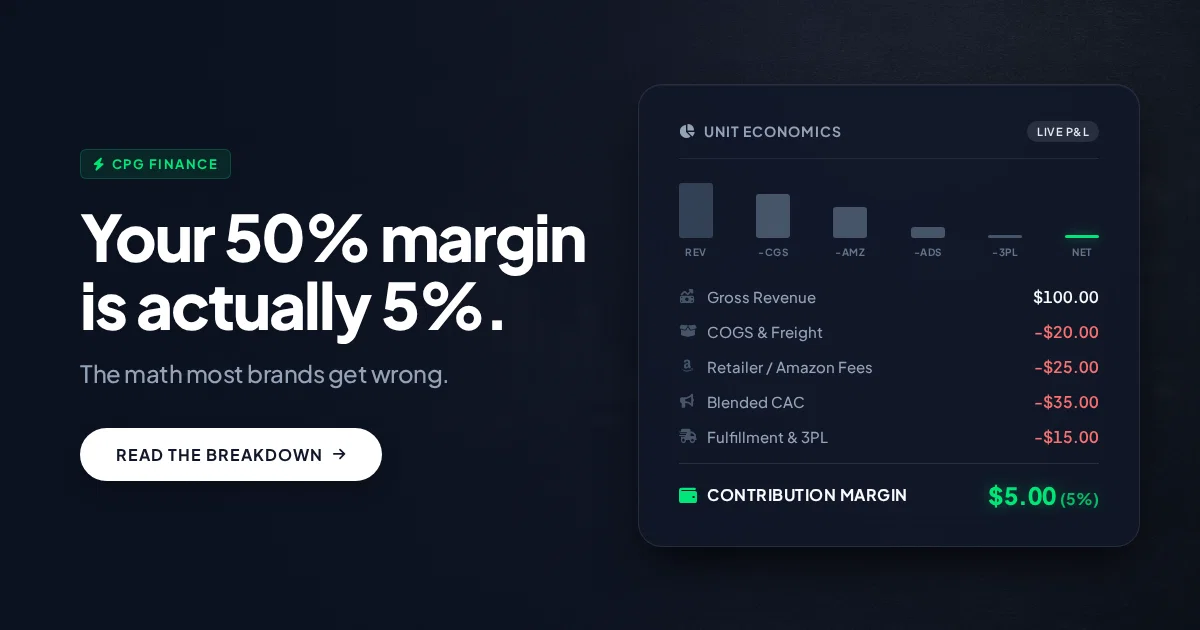
Here's a real scenario. A brand doing $100,000 per month on Amazon reports a 50% gross margin. Feels good. But watch what happens when you run the actual contribution margin math.
Cost Category | Amount | % of Revenue |
Revenue | $100,000 | 100% |
COGS (50% gross margin) | $50,000 | 50% |
Amazon Referral Fee (~15%) | $15,000 | 15% |
FBA Fulfillment Fees (~$5/unit, 2,000 units) | $10,000 | 10% |
Returns (~5% of revenue) | $5,000 | 5% |
Ad Spend (TACOS 15%) | $15,000 | 15% |
Contribution Margin | $5,000 | 5% |
You thought you had 50%. You actually have 5%. Your brand is not scaling its way to profitability. It's scaling its way to a cash crisis.
This is not a hypothetical. It’s actually a regular Tuesday for a lot of CPG brands.
The 4 Contribution Margin Mistakes CPG Brands Make
1. Treating Gross Margin as the Finish Line
Gross margin is a starting point, not a verdict. The moment you list on Amazon or run a paid social campaign, your gross margin number becomes almost meaningless for channel-level decisions. You need a contribution margin.
2. Ignoring Channel-Specific Fees
Every channel has its own fee structure, and they add up fast.
Amazon: Referral fees run around 15% for most categories, plus FBA fees of roughly $4 to $8 per unit depending on size and weight, plus storage fees if your inventory sits.
TikTok Shop: Commission rates currently range from 2% to 8% depending on category, plus fulfillment costs if you use their warehousing.
Shopify: Payment processing fees of 2.9% plus $0.30 per transaction (or less with Shopify Payments), plus any app fees baked into your stack.
Retail / Wholesale: Retailer margin (often 40% to 50%), freight, slotting fees, promotional allowances, and chargebacks.
None of these show up in gross margin. All of them show up in YOUR bank account.
3. Leaving Ad Spend Out of the Calculation
This one is controversial and also completely correct. Ad spend is a variable cost. If you stop selling, you stop spending on ads. It scales with revenue. It belongs in your contribution margin calculation.
A brand running 20% TACOS on Amazon is spending $20,000 to generate $100,000 in revenue. That is not a marketing line item you can ignore when evaluating channel profitability. It is a direct cost of selling on that channel.
When you include ad spend, a lot of "profitable" Amazon businesses stop looking profitable. That's not bad news, it's accurate news. You can't fix what you can't see.
4. Looking at Blended Numbers
Blended contribution margin across all channels is a vanity metric. Your Shopify DTC channel and your Amazon channel have completely different cost structures. At the same time, your retail business has different economics than your TikTok Shop. Averaging them together tells you nothing useful.
The brands that make smart channel decisions such as where to invest, where to pull back, where to negotiate better terms; are the ones looking at channel-level contribution margin. Not blended. Not approximate. Channel by channel, SKU by SKU.
What Good Contribution Margin Looks Like by Channel
There's no universal "good" number, but here are realistic benchmarks for CPG brands operating at scale.
Channel | Typical Gross Margin | Realistic Contribution Margin |
Amazon (with ads) | 45-55% | 10-25% |
Shopify DTC (with ads) | 55-65% | 20-35% |
TikTok Shop (with ads) | 50-60% | 15-30% |
Retail / Wholesale | 40-50% | 15-25% |
Amazon (organic, low TACOS) | 45-55% | 25-35% |
The spread between gross margin and contribution margin is widest on Amazon, which is exactly why so many brands over-invest there without realizing the channel is barely contributing to overhead coverage.
How to Actually Calculate Contribution Margin for Your Brand
You need a channel-level P&L. Not a blended income statement. A view that shows, for each channel, every dollar of revenue and every variable cost associated with generating it.
Here's the build:
Start with net revenue per channel (after returns and refunds)
Subtract COGS allocated to that channel
Subtract all channel fees (referral, fulfillment, storage, commissions)
Subtract shipping costs specific to that channel
Subtract ad spend attributed to that channel
Subtract payment processing fees
What's left is your contribution margin?
Do this monthly. Track it over time. Watch how it moves as your TACOS shifts, as FBA fees change, as your return rate fluctuates. This is the number that tells you whether a channel is worth growing.
Why This Matters
Contribution margin is not just an accounting exercise. It is the foundation of every channel investment decision you make.
Should you scale Amazon or double down on DTC? The answer lives in your channel-level contribution margin. Should you take that retail deal? Run the contribution margin math first like retailer margin, freight, promotional spend, and chargebacks included. Is TikTok Shop worth the operational lift? Only if the contribution margin justifies it.
Brands like Jones Road Beauty, Omnilux, and Peach & Lily are not guessing at these numbers. They're running clean channel-level P&Ls and making decisions based on what the math actually says.
The brands that scale profitably are the ones that know their contribution margin by channel, by SKU, and by month. The brands that raise a Series A and then quietly run out of cash are usually the ones that didn't.
Our Take
At Iris Finance, we build channel-level P&Ls for CPG brands as a core part of what we do, not as a one-time deliverable, but as a living financial system that updates monthly and tells you exactly where you're making money and where you're not.
Our software gives you the channel-level view. Our finance strategists are operators who've actually run CPG finance, not generalist consultants and they help you interpret it and act on it. Drew Fallon, our founder and a Forbes 30 Under 30 honoree in Food & Beverage, built Iris specifically because CPG brands deserve finance infrastructure that speaks their language.
If you're doing $1M or more in revenue and you're not 100% sure what your contribution margin is by channel, that's the conversation we should be having.
Learn more about your profitability today.
FAQ
Q: What is the difference between contribution margin and gross margin?
A: Gross margin subtracts only COGS from revenue. Contribution margin subtracts all variable costs, including channel fees, shipping, ad spend, returns, and payment processing. For CPG brands selling on Amazon, TikTok Shop, or retail, contribution margin is almost always significantly lower than gross margin and is the more accurate measure of channel profitability.
Q: Should ad spend be included in contribution margin?
A: Yes. Ad spend is a variable cost so it scales with revenue and stops when you stop selling. Including it in your contribution margin calculation gives you a true picture of what it actually costs to generate a sale on a given channel. Brands that exclude ad spend consistently overestimate channel profitability.
Q: What is a good contribution margin for a CPG brand on Amazon?
A: After accounting for referral fees, FBA fees, ad spend, and returns, a realistic contribution margin on Amazon ranges from 10% to 25% for most CPG brands. Brands with strong organic rank and lower TACOS can push toward 30% or higher. Anything below 10% means the channel is barely covering variable costs and contributing almost nothing to fixed overhead.
Q: How often should CPG brands review contribution margin?
A: Monthly at minimum. Contribution margin shifts with ad spend efficiency, fee changes, return rates, and promotional activity. Brands making channel investment decisions quarterly without monthly contribution margin data are working with stale information.
Related posts
Actionable data, proven strategies, and clear forecasts, empowering you to make smarter decisions and scale with confidence.